
The first time I hired a virtual assistant I was 100% sure it was going to change my life.
The second time too. And the third.
By the fifth I had stopped saying “this is going to change my life” and started saying “please, just this one.” I had a 22-tab onboarding document. I had loom videos. I had a Notion workspace so meticulously labelled that my last VA told me it was “the most organized thing she had ever seen.”
She quit six weeks later.
If you’ve been running a business by yourself long enough, you know the specific ache of writing your fifth version of the same training document. Not because the last VA was bad — most of them weren’t. But because every time someone new arrives, the whole system starts over. Every question you already answered. Every process you already explained. Every judgment call you already showed someone how to make.
The problem isn’t that virtual assistants don’t work. The problem is that a solo business owner ends up spending more time training help than doing the work the help was supposed to relieve.
Sponsored · Productive Studio What could your AI be doing while you sleep? Two minutes tells you where you stand — and what to hand over first. Take the quiz →The VA merry-go-round is real (and it has a name)
This isn’t in your head. Studies of small-business labor turnover show that assistants and support-role hires — especially remote and contract ones — cycle out at roughly 2-3x the rate of employees in traditional office roles. For most solo founders I’ve talked to, the average VA tenure is somewhere between 4 and 9 months.
Which means: every year, minimum, you’re re-hiring, re-onboarding, re-training. Every year the tacit knowledge in your business gets partially reset. Every year the “she’ll figure it out” tasks land back on your plate for two months while the new person figures it out.
And every year the internal calculation gets a little harder:
“Is it faster to just do it myself?”
Almost always the answer is yes. And you resent that answer, because you didn’t build a business so you could keep being the intern. But the math doesn’t lie — the cost of onboarding someone new is often higher than the cost of one more month of you doing it.
This is the trap. And it isn’t a personality problem or a VA problem or a systems problem. It’s structural.
 The operator in this postPixel — Visual CreatorBrief it plainly. It holds your brand.
See Pixel
The operator in this postPixel — Visual CreatorBrief it plainly. It holds your brand.
See Pixel
Why AI operators aren’t the same as “getting a bad VA”
Here’s where I want to be careful. I’m not going to tell you AI is going to replace human help. That’s not what this is about. Real people bring real judgment to real relationships, and there are parts of your business where you want a human — not a system — to be the answer.
What AI operators actually replace is the training, turnover, and re-hiring cycle that eats your year.
The reason is technical, but the impact is very human: an AI operator holds context permanently. You brief it once — your voice profile, your offer schedule, your platform mix, your rules of thumb, your don’t-do-these-things list — and the profile stays. Six months from now it hasn’t forgotten. It hasn’t quit. It hasn’t onboarded a new manager who needs to re-learn your quirks. The context you loaded in month one is still what the operator is running on in month twelve.
That’s the thing solo business owners have been missing. Not more labor. Persistent context — a system that stays trained.
The way I explained it to a friend last month: it’s like hiring somebody once and them just… never leaving. Never asking for a raise. Never needing you to explain the difference between the two brands again. Never turning over the account to someone new.
That’s not a virtual assistant. That’s what a virtual assistant was supposed to be, before the churn cycle set in.
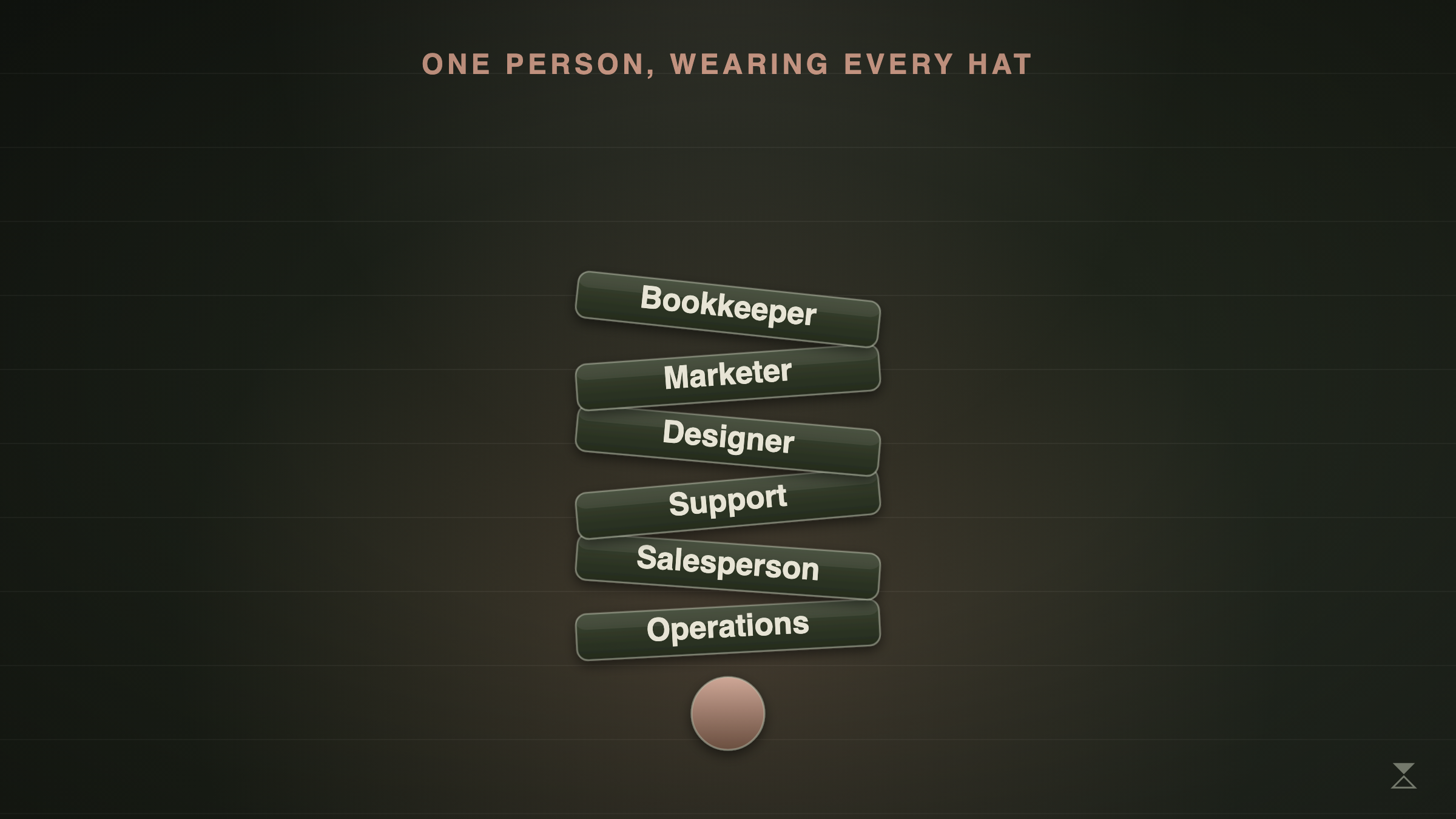


When AI replaces vs. augments (this matters)
Not every task in your business belongs to an operator. Here’s my honest breakdown after 15 months of building this way across five businesses:
Great fit for AI operators (replace):
- Content drafting, scheduling, publishing — Quill runs this in mine.
- Bookkeeping — categorization, receipt matching, reconciliation, month-end. Ledger runs this in mine.
- Research — market, competitor, vendor, topic. Anything you’d otherwise open 15 tabs for.
- Admin — filing, organizing, sorting, findability.
- Ads copy variants, SEO briefs, visual asset production.
Great fit for AI-augmented humans (partner):
- Direct client relationships. Anything involving trust, judgment, or care.
- High-stakes negotiation. Contracts, partnerships, hires.
- Strategic decisions that require reading the room.
- Creative direction. AI executes; you (or a real creative partner) direct.
The people who get burned trying to replace all their help with AI are the ones who confuse those two categories. The people who get back their evenings are the ones who let AI operators own the first list, so the humans in their business can focus on the second.
You’re not firing your team. You’re firing the busywork so your team has room to do the work that only humans can do.
What actually changes when you stop being the bottleneck
The version of solo business ownership most people picture — where you build, you sell, you serve, you scale — assumes something quietly cruel: that everything in the middle (the tasks, the training, the coordination) is either free or invisible. It isn’t. It’s the largest hidden cost of running a business alone.
When AI operators own the middle, the whole shape of your week changes. Not because you’re working less overall — most of the founders I know work about the same. But because what they’re working on shifts.
Two months in:
- The 40 minutes a day you spent on content is gone.
- The 4 hours a week on bookkeeping is gone.
- The 2 hours a week on scheduling and coordination is mostly gone.
- The 6 hours a month of onboarding + retraining is gone.
- The onboarding docs you keep re-writing? Not needed.
Six months in:
- You start noticing you’ve been thinking more strategically. Not because you tried to. Because the tactical layer stopped eating your brain.
- Your work has more edges again. It’s not blurry all the time.
- You reply to your clients faster and more thoughtfully. Because they’re the humans in front of you.
That’s the shift. It’s not “I’m running an AI team now.” It’s “I’m running my business again.”
 Pairs well with thisCharter — Flowchart BuilderTurns a process you only know by heart into a diagram.
See Charter
Pairs well with thisCharter — Flowchart BuilderTurns a process you only know by heart into a diagram.
See Charter
What to do if you’re on the VA merry-go-round right now
If you’re mid-cycle — either between VAs or dreading the next hire — here’s my honest ask.
Don’t hire your sixth VA before you look at what your business actually needs day to day. Make the list. Not the “what would be nice to delegate” list. The “what did I do this week that I’ve explained to someone else three times already” list.
That list is your operator brief. Every item on it is a candidate for a trained AI operator instead of a trained assistant. The ones that stay on the human side get more of your team’s attention — not less. Because now they’re not being asked to also do the content, the receipts, the admin, the research.
You’ll spend a few weeks briefing your first operator. Then it stays trained. Forever. That’s the trade.
If you want a place to start, the AI COO Setup Kit is the foundation everything else runs on — the same one I use across my five businesses. Or if content is the specific thing eating you, Quill is running my content calendar right now, no VA required.
The team you’d hire is still available. It’s just not who you thought it was.
~ Elfina
The Trained Team Five operators, trained and ready — one time, never a subscription. See the team →